
The Alexander Technique helps people recognize and change habitual patterns of tension that contribute to back pain. By improving posture and coordination, many people experience less strain in everyday activities.
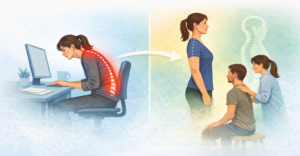
Poor posture habits can place unnecessary strain on the spine.
Back pain is one of the most common reasons people become interested in the Alexander Technique. Many people try stretching, strengthening exercises, or posture corrections in an effort to relieve discomfort. These approaches can sometimes help temporarily, but the pain often returns. One reason is that the underlying cause may involve habitual patterns of tension and movement that occur during everyday activities.
Many people first learn about the Alexander Technique when looking for ways to improve posture and reduce strain. The Alexander Technique approaches back pain from the perspective of how the whole body works together. Instead of focusing only on the back itself, the Technique considers how a person sits, stands, walks, and responds to everyday situations.
These patterns of use can have a strong influence on the amount of strain placed on the spine.
Habitual Patterns and Back Strain
Many people unknowingly tighten their neck, shorten their spine, or stiffen their torso when concentrating or reacting to stress. These responses can occur while working at a computer, driving, standing in line, or even during conversation.
Over time these habits may compress the spine and reduce the body’s natural ability to balance and move efficiently. The result can be fatigue, stiffness, or pain in the back.
People often attempt to solve this problem by “fixing” their posture—pulling their shoulders back or holding themselves rigidly upright. While this may seem helpful, it frequently adds another layer of tension.
You can read more about back pain and the Alexander Technique elsewhere on this site.
A Different Perspective on Posture
In Alexander Technique lessons, students learn to observe these patterns and gradually reduce unnecessary tension. Teachers often draw attention to the relationship between the head, neck, and spine.
When the neck is relatively free and the head balances easily on the spine, the back tends to lengthen and widen naturally. This allows the body to support itself with less muscular effort.
This approach differs from traditional posture correction, which often encourages people to hold themselves in a fixed position. Instead, the Alexander Technique emphasizes coordination and balance.
You can explore more about this idea in the section about posture and body use.
Everyday Activities Matter
Back strain often develops during ordinary activities rather than dramatic movements. Sitting at a desk, standing for long periods, or bending to pick something up may all contribute to patterns of tension.
By becoming more aware of these habits, it becomes possible to interrupt them before they create unnecessary strain.
A Process of Learning
The Alexander Technique does not promise an instant cure for back pain. Instead, it offers a process of learning about how you use your body.
As people develop greater awareness and coordination, they often find that their movements become easier and more balanced. In many cases, this reduces the strain that contributes to ongoing back discomfort.
Related pages