
How the Alexander Technique complements yoga, bringing greater awareness and depth to your practice
Many yoga practitioners discover the Alexander Technique and realize they’ve found the missing piece. Yoga is extraordinarily valuable. It combines physical movement, breathing, and meditation beautifully. But it doesn’t inherently teach you how to move efficiently or recognize and release habitual tension patterns. Even experienced yogis often carry unnecessary tension into their practice. This creates potential for injury and limits how fully they can access benefits. The Alexander Technique provides exactly what many yoga practitioners need: a systematic method for developing body awareness and releasing tensions that interfere with yoga’s full benefits.
Many people begin yoga practice expecting that regular practice will naturally improve their posture and movement quality. To some extent, it does. Yoga’s emphasis on stretching, strengthening, and breath awareness can improve overall function. But yoga teaches specific poses and breathing techniques without necessarily addressing the habitual patterns that interfere with optimal alignment and movement.
Someone might practice yoga regularly yet continue hunching their shoulders forward during daily life. They might practice backbends but still compress their lower spine through habitual forward-tilting pelvis patterns. They might practice breathing exercises but still habitually hold tension in their jaw and throat that restricts natural breathing. There’s a disconnect between yoga class and real life. And yoga classes don’t systematically address how you use yourself during non-yoga activities.
You might practice perfect alignment during a yoga class and immediately return to your habitual patterns as you go about your day. While this is better than not practicing yoga, it means you’re not fully capturing yoga’s transformational potential.
When you bring Alexander Technique principles to your yoga practice, your asana work becomes dramatically more effective and safer. The concept of “primary control”—the relationship between your head, neck, and spine—directly affects how you can move in yoga poses. When your neck is free and your head is balanced naturally on your spine, your entire spine naturally lengthens and your asanas become more efficient.
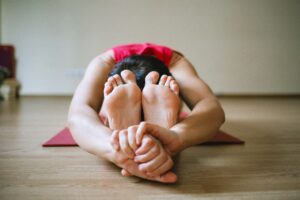
This isn’t about forcing yourself into “correct” alignment. It’s about allowing natural alignment to emerge as unnecessary tension is released. Consider a forward bend. Without Alexander Technique awareness, you might round your entire spine and collapse toward your legs, losing the lengthening that creates safe, effective stretching. As you develop Alexander Technique awareness, you learn to maintain length in your spine while you bend. The stretch distributes evenly throughout your spine rather than compressing your lower back. The pose becomes safer, more comfortable, more effective. This principle applies to virtually every yoga pose.
The Alexander Technique brings consciousness to how you move into and out of poses. In yoga, transitions are often overlooked. Attention focuses primarily on the final pose. But how you move into a pose is crucial for both safety and effectiveness. When you apply Alexander Technique principles to transitions—inhibiting habitual movement patterns and giving yourself constructive directions—you protect your joints and engage your muscles more effectively.
Pranayama, yoga’s breathing practice, becomes significantly more accessible when combined with Alexander Technique awareness. Many yoga students struggle with pranayama because physical tension and postural restrictions interfere with the full expansion and contraction of the ribcage necessary for advanced breathing practices. As you release postural tensions through Alexander Technique work, your ribcage becomes freer. Your diaphragm can function more fully. Breathing practices that once seemed difficult become accessible and natural.
Furthermore, the Alexander Technique principle of “inhibition”—the ability to pause before automatically responding—directly enhances meditative awareness. In both Alexander Technique and meditation, you’re developing the ability to observe your habitual responses without immediately acting on them. This creates a space of choice and conscious response. Many practitioners find that their meditation deepens as they develop the observational skills cultivated through Alexander Technique lessons.
Yoga’s ultimate goal is the integration of body, breath, and mind into unified consciousness. The Alexander Technique supports this integration by bringing conscious awareness to how habitual physical patterns affect your breath and mental state. As you become aware of how forward-tilted posture creates shallow breathing and mental tension, and as you learn to release these patterns, you naturally move toward the integrated state yoga seeks.
The technique doesn’t replace meditation or other yoga practices. It enhances them by creating the physical foundation of ease and freedom that allows deeper meditation and practice.
While yoga is generally safe, injuries do occur. Often because practitioners push too hard, don’t respect their body’s limitations, or practice with poor alignment. The Alexander Technique helps prevent injuries by bringing body awareness to your practice. As you develop the ability to notice tension and restriction before they become problematic, you can modify your practice accordingly. You become attuned to the difference between healthy challenge and potential injury risk. Many yoga teachers have observed that students studying Alexander Technique have far fewer injuries and progress more steadily in their practice
Both yoga and the Alexander Technique are rooted in the principle of conscious awareness and intelligent self-direction. The yoga concept of “mindfulness”—paying attention to what’s actually happening moment to moment without judgment—aligns perfectly with the Alexander Technique’s emphasis on awareness and observation. Both disciplines teach that by becoming more conscious of how we’re using ourselves and our minds, we can fundamentally transform our experience and capabilities. A yogi studying the Alexander Technique often feels that the technique provides practical, daily tools for embodying the consciousness that yoga philosophy describes.
For yoga practitioners at all levels, the Alexander Technique offers a way to deepen and refine practice. Beginning students benefit from learning efficient movement patterns before bad habits become entrenched. Intermediate students discover that understanding and releasing tension patterns removes plateaus in their practice and opens access to poses and breathing practices that previously seemed difficult. Advanced students find that the refined awareness developed through Alexander Technique work allows for even greater subtlety and depth in their practice.
The combination of yoga and Alexander Technique represents a comprehensive approach to physical, mental, and spiritual development. Yoga provides the framework for understanding consciousness and the tools for meditation and awareness. The Alexander Technique provides practical, everyday tools for releasing tension, improving alignment, and bringing conscious awareness to every activity. Together, they create a powerful path toward greater health, awareness, and wholeness.
More information about yoga and the Alexander Technique: alexandertechnique.com/applications/yoga