
How a simple lying-down position can release deep tension, restore nervous system balance, and become one of your most valuable practices
Among the valuable practices within the Alexander Technique, one of the simplest and most powerful is the constructive rest position. It’s remarkably simple—you lie on your back with your knees bent. That’s it. Yet the effects are profound. People describe feeling more relaxed, mentally clearer, and physically restored after just fifteen minutes. Those who practice it regularly report significant improvements in chronic pain, stress levels, and overall wellbeing. Yet despite its remarkable benefits, constructive rest remains little-known outside Alexander Technique circles—an untapped resource for anyone seeking deeper relaxation and healing.
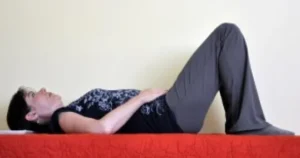
The position is deceptively simple: lie on your back on a firm surface (a firm bed, a yoga mat, or a carpeted floor). Bend your knees at approximately ninety degrees. Keep your feet flat on the floor, hip-width apart, about one foot away from your body. Your arms rest at your sides, palms down, or can be crossed over your chest. Your head rests on a small support—usually a few books or a specifically designed support—positioned so your spine remains neutral without tilting your head backward.
In this position, you simply rest quietly, allowing your nervous system to reset and your muscles to release tension. What makes this position “constructive” rather than simply lying down is that it’s specifically designed to allow your spine to settle into its natural curves while your entire body is supported without having to create any muscular effort. Unlike lying flat, which can hyperextend your lower back, or lying on your side, which creates asymmetrical tension patterns, this position is biomechanically optimal for allowing deep relaxation throughout your entire body.
When you’re standing or sitting, your postural muscles must constantly work against gravity to support your body. Even when you’re not conscious of it, these muscles are engaged, holding tension to maintain your position. Over the course of a day, this accumulated muscular effort contributes significantly to fatigue and tension.
Most people’s idea of rest is to sit or lie down while watching television or using their phone. But this passive rest doesn’t genuinely allow the postural muscles to release because they’re typically held in patterns of tension even during these supposedly restful activities. Constructive rest is different. Because your body is fully supported and your head is specifically positioned to allow your cervical spine to be in neutral, your postural muscles don’t need to create any effort. They can genuinely relax. As your muscles relax, your nervous system perceives that you’re safe and supported. Your parasympathetic nervous system activates, promoting relaxation and recovery. Over just fifteen or twenty minutes in this position, deep restoration occurs.
Most people accumulate tension throughout their days without realizing it. The accumulation is gradual. A little tightening in the shoulders while working at a computer. Some neck tension during a stressful meeting. Backache from sitting in a car. Foot soreness from standing all day. By evening, the accumulated tension is significant, yet the person might not consciously notice it. They just feel tired and achy without understanding why.
Constructive rest position provides a way to systematically release this accumulated tension. As you lie in the position for fifteen to twenty minutes, tension gradually lets go throughout your entire body. Your shoulders drop as they release the tightness accumulated during the day. Your neck softens. Your lower back releases the excessive curve often created by forward-leaning postures. Your jaw and facial muscles let go of tension you didn’t even realize you were holding. This systematic release is one of the most valuable effects of the practice.
Modern life keeps most people in a state of chronic low-level sympathetic nervous system activation—the “fight-or-flight” response. This activation is adaptive when you’re actually facing threats, but it becomes problematic when chronically sustained in response to psychological stress. Chronic sympathetic activation contributes to elevated blood pressure, impaired digestion, weakened immune function, and poor sleep.
Constructive rest position is one of the most effective ways to shift out of this state. When you lie in this position, your nervous system perceives safety. You’re physically supported. There’s nothing you need to do. Your body isn’t in a position of readiness or defense. These signals trigger a shift toward parasympathetic activation—the “rest and digest” state. In this state, your body can heal, your immune system can function optimally, your digestion improves, and your stress hormones decrease. Regular practice of constructive rest essentially provides regular “resets” for your nervous system, maintaining it in a healthier baseline state.
People with chronic pain conditions often report that constructive rest position provides significant relief. The relaxation of postural muscles that are often braced in response to pain creates a gentle interruption of the pain cycle. When you’re not creating protective tension around the painful area, pain sensation often decreases. Additionally, the parasympathetic activation that occurs in the position supports healing processes that are inhibited by chronic stress and tension.
Similarly, athletes and physically active people often use constructive rest position as a recovery tool. The fifteen to twenty minutes of complete muscular relaxation speeds recovery from training. Many athletes report that regular constructive rest practice has allowed them to train more consistently and effectively because they’re recovering faster and maintaining lower baseline tension.
Beyond physical relaxation, constructive rest position provides mental clarity and emotional stability. Many people report that their minds naturally become quieter while resting in this position. Intrusive thoughts decrease. Mental clarity increases. Emotional reactivity decreases. These benefits likely result from the nervous system shift toward parasympathetic activation combined with the freedom from environmental stimulation if you practice without distractions. Regular practice often leaves people feeling not just physically rested but mentally and emotionally more stable.
The beauty of constructive rest position is its simplicity and accessibility. You don’t need any special equipment beyond some books or a pillow for your head support. You can practice anywhere—at home, in an office, even in a car parked in a quiet location. The recommended practice is fifteen to twenty minutes daily, though even five to ten minutes provides benefit. Many people find the ideal time is the end of the day, just before or after work, providing a clear boundary between activity and evening rest. Others practice in the morning to start their day from a place of calm clarity.
The practice is entirely passive. You’re not doing anything, just lying and allowing relaxation to occur. If your mind wanders, that’s fine—simply return your attention to your body. If you fall asleep, that’s also fine and indicates your nervous system needed that rest. With consistent practice over weeks and months, you’ll notice accumulated benefits: better sleep, improved mood, less chronic pain, greater resilience to stress, and a general sense of greater wellbeing. This simple practice, costing nothing and requiring no special skills, may be one of the most valuable contributions the Alexander Technique makes to modern health and wellness.
More information about Alexander Technique Constructive Rest: alexandertechnique.com/constructiverest