
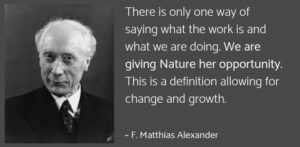
How an Australian actor’s personal struggle led to a discovery that transformed millions of lives
Most people have never heard of F. Matthias Alexander. Yet his discovery has influenced musicians, actors, dancers, athletes, educators, and people seeking health and wellbeing for over a century. Born in 1869 in Wynard, Tasmamia, Alexander was a talented actor and reciter who faced an obstacle that seemed insurmountable: he was losing his voice. During performances, his voice would become hoarse and eventually fail completely. He couldn’t continue his career. Desperate, he embarked on a journey of self-discovery that would lead not just to restoring his voice but to developing a technique that continues to transform lives today.
In the 1890s, as Alexander’s voice problems worsened, he consulted numerous specialists and throat doctors. They found nothing physically wrong with his larynx. Yet the symptoms persisted. Despite their advice, his voice continued to deteriorate. This forced Alexander to become a researcher of his own problem. If doctors couldn’t identify a physical cause, perhaps the problem lay in how he was using his voice and body while performing. That simple question—how am I using myself?—became the foundation of everything.
Alexander’s investigation was rigorous. He used mirrors to observe himself while reciting, watching carefully to notice what happened to his body when his voice problems occurred. What he discovered was striking: when he recited, his head moved backward and down, his back contracted, and his entire body tensed. He wasn’t conscious of doing this. Yet this habitual pattern seemed directly connected to his voice problems. When his neck was free and his head moved naturally, his voice worked beautifully. When he fell into his habitual pattern, his voice deteriorated.
What distinguished Alexander from mere self-observation was his systematic, scientific approach. Understanding the problem wasn’t sufficient. He needed to be able to consistently choose a different response. He developed the concept of “inhibition”—the ability to pause before automatically responding to a stimulus—and “direction”—the capacity to mentally guide his body toward more efficient movement without physical force.
Through patient, methodical practice, Alexander learned to interrupt his automatic response and direct himself toward freer, more efficient movement. The result was remarkable: his voice completely recovered. But more importantly, he discovered that this problem-solving approach wasn’t specific to voice. The principles—recognizing that habitual patterns interfere with optimal function, the ability to inhibit automatic response, the power of conscious mental direction—could be applied to any activity.
Recognizing the broader significance of his discovery, Alexander moved to London in 1904. London was then the center of the English-speaking theatrical world, and his reputation gradually grew among performers who recognized the dramatic improvements in their ability to express themselves physically and vocally when they released unnecessary tension.
It was on one of his trips to teach in America, that Alexander encountered John Dewey, the renowned American philosopher and educator. Dewey wasn’t just a student—he became a passionate advocate for Alexander’s technique. Dewey recognized that Alexander had made a fundamental discovery about how humans learn and change. By becoming aware of habitual patterns and consciously directing new responses, individuals could fundamentally transform how they functioned. This intellectual validation from one of the era’s greatest minds gave Alexander’s work credibility far beyond theater circles.
Dewey’s support opened doors. Other prominent figures were drawn to the technique. George Bernard Shaw endorsed it. Aldous Huxley became a student. These weren’t people drawn to fads. They were serious thinkers who recognized that Alexander had discovered something fundamental about human function and potential.
What gave Alexander’s technique lasting credibility was that it wasn’t merely anecdotal. Alexander himself insisted that his discovery needed to be studied carefully and systematically. He emphasized that the technique should be tested and verified, not simply accepted on authority. This commitment to rigorous observation and verification has been maintained throughout the history of the technique and is one reason it has earned respect even in scientific and medical communities.
Recognizing that disseminating his technique depended on training qualified teachers, Alexander established the first teacher training course in London in 1931. This three-year program set the standard for Alexander Technique teacher preparation that continues today. Teachers train extensively in how to observe students, recognize habitual patterns, and guide students toward more efficient use of themselves. The training emphasizes both theoretical understanding and personal skill—a teacher must have refined their own use of themselves before effectively teaching others.
Alexander continued teaching and writing until his death in 1955 at age eighty-six. He wrote four books detailing his discoveries: “Man’s Supreme Inheritance,” “Constructive Conscious Control of the Individual,” “The Use of the Self,” and “The Universal Constant in Living.” These books remain in print and continue to influence readers more than sixty years after his death. In them, Alexander articulated not just the mechanical principles of his technique but his philosophy of human development and the possibility of conscious evolution.
In his later years, Alexander’s technique had expanded far beyond performing arts. Teachers were using his principles in schools. Doctors were recognizing its value for various health conditions. Educators were incorporating his ideas about conscious learning into their practice. Yet Alexander himself remained modest. He saw the technique not as his creation but as a rediscovery of how humans were designed to function—principles obscured by centuries of habitual patterns but recoverable through conscious attention and practice.
More than seventy years after F. Matthias Alexander’s death, his technique continues to influence diverse fields. Musicians and actors study it to enhance performance. People with chronic pain use it for relief. Athletes apply its principles to improve performance. Educators use its insights to understand how people learn. Mental health professionals recognize its value for stress and anxiety. Scientific researchers investigate the mechanisms through which the technique produces its effects.
In all these applications, Alexander’s fundamental insight remains central: how we use ourselves matters profoundly, and through conscious awareness and intelligent direction, we have the capacity to change and improve. What began as one man’s solution to his own voice problem became a comprehensive approach to human development that continues transforming lives today.