
by Robert Rickover
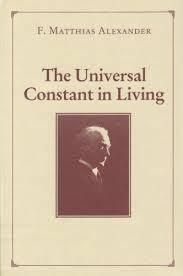
The Universal Constant in Living is F. M. Alexander’s fourth book, published in 1942. Where The Use of the Self tells the story of his discovery, this book widens the lens — applying the principle of “use” to medicine, education, physiology, sport, and the state of the world itself, in the years surrounding the Second World War.
With the help of AI I’ve put together key passages, and provided a little context for each one below. (For the first two key passages, I’ve also included a “plain meaning” passage because those key passages can be confusing for people not familiar with the Technique.)
The Man Who Watched Himself in Mirrors: F. M. Alexander’s Four Books provides short summaries of all four of Alexander’s books. (They have a somewhat different approach than the one taken by Ron Brown in his Authorised Summaries of F. M. Alexander’s Four Books, which I highly recommend. It can be purchased from the Society of Teachers of the Alexander Technique and from Mouritz.)
If you are intrigued by these passages and want to learn more, The Universal Constant in Living is available from Amazon.
This is an experiment and I’d love to hear if it’s been helpful for you.
1. On the constant that gives the book its title
The quote: “It has not been realized that the influence of the manner of use is a constant one upon the general functioning of the organism in every reaction and during every moment of life, and that this influence can be a harmful or a beneficial one… Hence this influence can be said to be a universal constant in a technique for living.”
(In plain language: Most people don’t realize that how you use your body affects everything you do, all the time — every movement, every reaction. That influence is never neutral; it’s either helping you or hurting you. Because it’s always present, it’s not just one factor among many — it’s the underlying constant that shapes everything else.”
The context: This is the idea the whole book is built around. Alexander isn’t describing one habit among many — he’s describing a single underlying factor (how we use ourselves) that is always operating, for better or worse, in absolutely everything we do. Good posture isn’t a separate project from good health, good thinking, or good relationships; the same “constant” runs through all of them. Once you see it, you can’t unsee it — which is exactly the shift the Technique is designed to bring about.
2. On two ways of trying to get what you want
The quote: “According to the first or end-gaining conception, all that is necessary when an end is desired is to proceed to employ the different parts of the organism in the manner which our feeling dictates as necessary for the carrying out of the movements required for gaining the end, irrespective of any harmful effects due to misuse of the self during the process.”
(In plain language: The first approach — “end-gaining” — means going straight for the goal: you feel like you know what to do, so you just do it, using your body however feels natural in the moment, without stopping to consider whether that way of moving is actually hurting you. The goal is all that matters; the means are an afterthought.)
The context: Alexander called this “end-gaining” — going straight for the goal without considering how you get there. He contrasts it with the “means-whereby”: thinking through the process itself, and being willing to change it if it isn’t serving you. This single distinction shows up again and again in the book, applied to everything from golf swings to factory reform to international politics. The lesson is the same at every scale: fixating on the result almost guarantees you’ll keep using the same flawed method to chase it.
3. On why instructions and willpower keep failing
The quote: “Established habits of use and unreliable feeling… the difference between ‘being right’ and ‘feeling right.’”
The context: This phrase, drawn from Alexander’s discussion of habit, points to something students of the Technique discover again and again: what feels “right” to us is simply what’s familiar, not what’s actually correct. Telling someone to sit up straight, breathe deeply, or relax doesn’t work for long, because their internal sense of “right” is calibrated to the very habit that’s causing the problem. Real change means temporarily trusting a process over a feeling — which, as Alexander shows throughout the book, is far harder than it sounds.
4. On medicine missing half the diagnosis
The quote: “Why influence of patient’s manner of use upon his general functioning is a potent factor in inducing and maintaining conditions of ill-health or well-being — where medical training falls short in assessing this influence.”
The context: A large section of this book is addressed directly to the medical profession, drawing on letters and case histories — torticollis, stuttering, asthma, sciatica, the aftermath of accidents — sent to Alexander by doctors of the period. His argument was provocative for its time and remains relevant: a diagnosis that only examines the local symptom, without considering the patient’s whole manner of using themselves, is necessarily incomplete. Treating the part while ignoring the use of the whole, he argued, often just allows the underlying cause to resurface elsewhere.
5. On habit, indulgence, and the trap of comfort
The quote: “Indulgence in relation to ‘feeling right’ and comfortable… abnormality and ‘cure’… habits of use and habits of abnormality and excessive craving.”
The context: Alexander draws a direct line between everyday postural habits and the broader human pattern of clinging to whatever feels familiar and comfortable, even when it’s doing us harm — whether that’s a slumped sitting position or a destructive craving. The common thread is the same unreliable internal compass: we keep returning to what feels normal, mistaking familiarity for safety. Breaking any habit, he suggests, requires recognizing this pattern first.
6. On the danger of trying your hardest
The quote: “When trying to be ‘right’ is the direct way to failure — ‘doing one’s best’ and a ‘dagger of the mind.’”
The context: It’s one of the more startling ideas in the book: that conscientiously “doing your best,” in the usual sense, often guarantees you’ll fail. If your best effort is still being guided by the same misdirected use and unreliable feeling, more effort just means more misdirection, applied more forcefully. Alexander’s alternative isn’t trying less hard — it’s changing what you’re directing your effort toward in the first place: the means, not just the end.
7. On knowing how to stop
The quote: “Mankind is now faced with new, unexpected, and tremendous problems… throughout his long career man has been content to make progress in acquiring control of nature in the outside world, without making like progress in acquiring its essential accompaniment — the knowledge of how to control nature within himself.”
The context: Writing in the shadow of the atomic bomb, Alexander makes his boldest claim: that humanity’s mastery over the external world has badly outpaced its mastery over its own reactions, and that this imbalance — not any single invention — is the deeper danger. It’s a striking expansion of his core idea, from the muscles of the neck all the way out to the fate of civilization, and it gives the book’s final chapters a real sense of urgency.
8. On why self-knowledge is the knowledge we skip
The quote: “Man’s most tragic mistake has been his failure to acquire knowledge of himself as an individual functioning as a psycho-physical whole in his daily activities, for this has deprived him of the key to knowledge which could give him a new technique in living.”
The context: Quoting the Rt. Hon. Herbert Morrison’s line that man is “so skilled in learning… so stupid in living,” Alexander makes the case that we pour enormous effort into mastering subjects entirely outside ourselves while remaining almost wholly ignorant of the one instrument we use to pursue all of it — ourselves. He saw this gap, not any lack of intelligence or good intentions, as the real obstacle to a saner, healthier way of life.
9. On testing any new idea before you trust it
The quote: “This test of principle, when applied generally, will be found to be a dependable means whereby the value of new plans can be gauged… too many people develop a mania for assuming the role of one to ‘show the way’ without first developing the mania for gaining the knowledge and experience which would justify them in assuming the role.”
The context: Alexander offers a simple but demanding filter for evaluating any reform, plan, or piece of advice: does it actually rest on a different principle than the approach it claims to replace, or is it the same old method wearing new language? He applies this test throughout the book to contemporary education, physical culture, and self-help movements of his day, with a dry skepticism toward anyone eager to lead before they’ve done the work of learning.
10. Professor G. E. Coghill’s appreciation
The quote: “It is a very different thing to state a theory and to demonstrate it as a fact. It is the demonstration that places the concept on a scientific foundation.”
The context: G. E. Coghill, the eminent anatomist whose decades of research into the development of behaviour in vertebrates closely paralleled Alexander’s own findings, contributes a substantial appreciation at the front of this book. His point here is a quiet but important one: plenty of people in Alexander’s time were starting to talk about “the whole person” as an ideal, but Alexander had actually built a repeatable, teachable method for bringing it about. It’s the difference, as Coghill saw it, between holding a belief and demonstrating a fact — and it’s why this book carries the weight of independent scientific endorsement alongside Alexander’s own argument.
For more information about the Alexander Technique: The Complete Guide to the Alexander Technique